ProChange Behavior Solutions: Building Bridges for Workplace Belonging
Work takes up roughly a third of our lives, and the environment in which we do it shapes far more than our careers. Belonging at work is a significant predictor of mental health and a measurable driver of organizational performance. When people feel they belong, they stay, engage, and thrive. When they don’t, the costs show up everywhere: in depression and anxiety, in lost productivity, and in the turnover and absenteeism that quietly impact organizations. In this way, belonging is not just an individual necessity, but an organizational one.
For LGBTQ+ employees, the stakes are especially high. Despite growing attention to workplace inclusion, LGBTQ+ workers continue to experience belonging at significantly lower rates than their peers. The tools meant to close that gap have rarely been designed with them specifically in mind. So how can we equip businesses and workers alike to cultivate healthy environments and find belonging at work?

The Challenge
LGBTQ+ people face well-documented health disparities across nearly every measure: higher rates of depression, anxiety, and chronic minority stress. The workplace is one such environment where those disparities can take root. Approximately 50% of LGBTQ+ workers experience some form of workplace discrimination or harassment due to their sexual orientation or gender identity. This includes being fired, denied a promotion, having work hours reduced, or experiencing verbal, physical, or sexual harassment.
What makes this challenge especially complex is the role of belonging specifically. Though the majority of U.S. LGBTQ+ employees believe being out at work is important to them, less than 50% feel safe being out with all of their colleagues. Being out has unpredictable results, and this tension creates chronic, low-grade stress with real health consequences.
Even organizations with formal non-discrimination policies aren’t immune. LGBTQ+ employees consistently report that written policies don’t automatically translate into supportive organizational culture or relationships with supervisors and colleagues. The gap between policy and lived experience is precisely where belonging breaks down. Addressing this gap requires more than good intentions and HR policy updates. It requires targeted, evidence-based solutions built with LGBTQ+ communities.
The Client
ProChange Behavior Solutions has spent nearly three decades translating behavior change science into real-world programs for employers, health systems, government agencies, and communities. Grounded in more than $20 million in federally funded research and 80+ peer-reviewed publications, the company combines scientific rigor with practical implementation expertise.
As a leading expert in optimizing workplaces, ProChange developed the IOWA-B (Inclusive Organizational Well-Being Assessment – Belonging), a validated measurement tool that quantifies workplace belonging and its effects on employee health and organizational outcomes. Their data showed that employees with stronger belonging scores reported better overall health, lower rates of depression and anxiety, and higher workplace productivity.
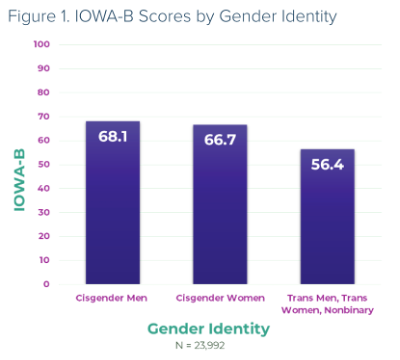
A deeper analysis of that same dataset revealed a critical gap: transgender and nonbinary employees scored more than 10 points lower on the IOWA-B than their cisgender counterparts. That finding made the need for a targeted, LGBTQ+-specific solution clear.
The Work
Eidos partnered with ProChange on their application for a Small Business Innovation Research grant to develop Bridges: a community-informed digital intervention designed to strengthen workplace belonging for LGBTQ+ employees. Eidos served as an academic partner, contributing LGBTQ+ health expertise, community networks, and research infrastructure to bring Bridges from concept to clinical trial.
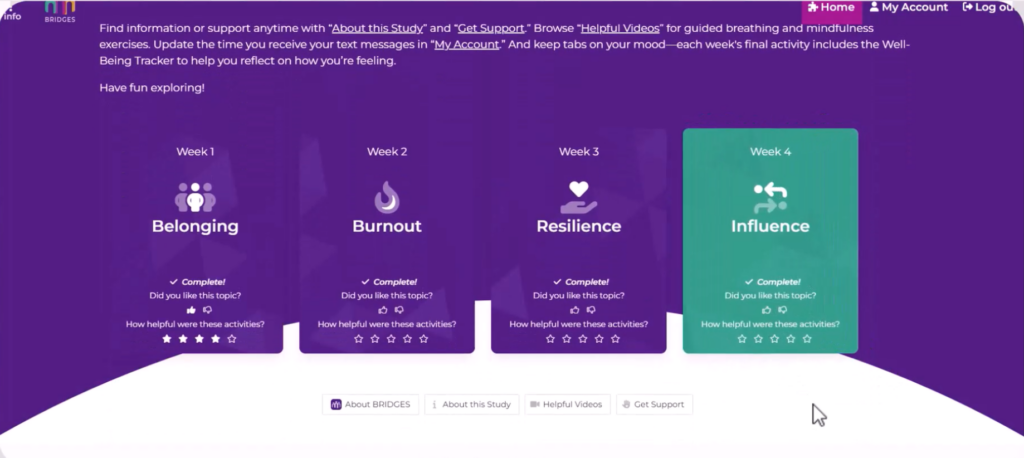
Grounded in ProChange’s evidence-based behavior change frameworks, Bridges combines brief online learning modules with daily tailored text messages to help users build connection, resilience, and agency within their workplaces. Critically, it was designed to give individual employees tools that work regardless of their workplaces’ current policies and organizational cultures.
The development process was built around co-creation from the start. Eidos recruited and convened a Community Advisory Board comprising LGBTQ+ community members alongside professionals with expertise in LGBTQ+ health, workforce development, and behavior science. This board was central to defining what belonging actually means in practice for LGBTQ+ employees and what an effective intervention would concretely need to do. Their input directly shaped the intervention model, ensuring Bridges was grounded in lived experience rather than generically applied wellness frameworks.
Alongside the advisory board’s guidance, Eidos contributed to core intervention design, working through what an identity-specific model could look like and how to build it around self-empowerment and power dynamics that would be applicable across diverse workplace contexts and demographics. Once the Bridges tool was fully developed, Eidos led recruitment for the pilot trial that would test the intervention for feasibility, acceptability, and efficacy.
The Results
The Bridges pilot recruited 137 LGBTQ+ full-time employees from across the United States to participate in the month-long testing program. Almost all the employees reported experiencing low to moderate senses of belonging in their workplace, and most attributed those feelings to their gender identity or sexual orientation. Over the course of the month, participants engaged with four learning modules and received daily tailored text messages focused on belonging, burnout, resilience, and influence.
The results were meaningful across every measure tracked:
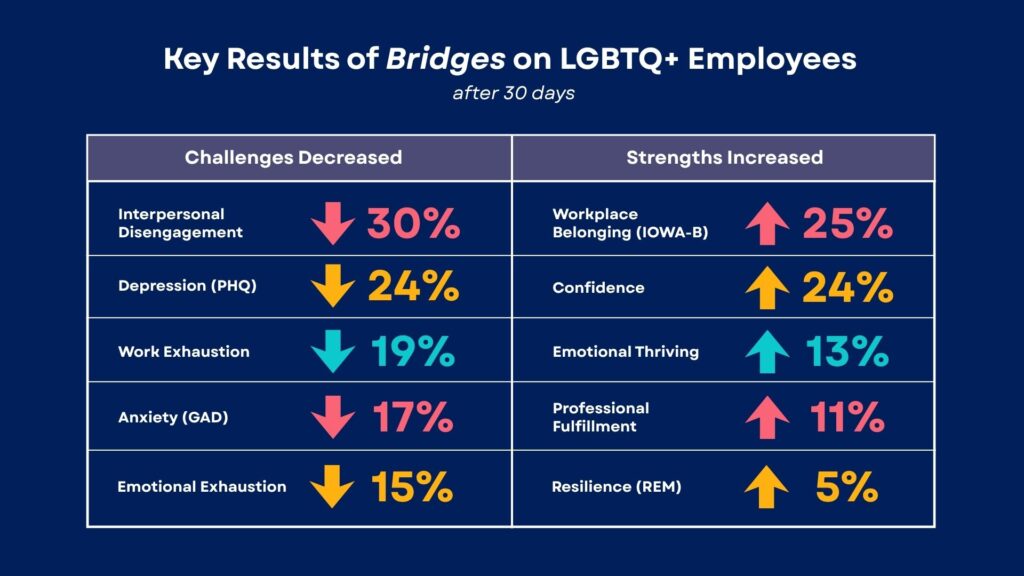
That 25% increase in IOWA-B belonging scores directly closes the gap ProChange’s original data had identified between LGBTQ+ employees and their cisgender peers.
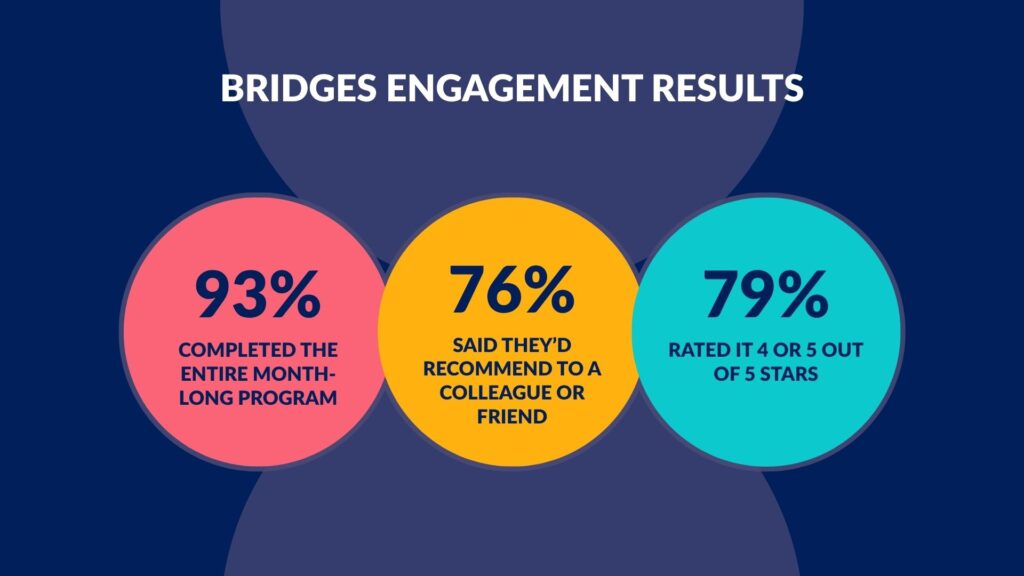
Engagement rates told their own story. 93% of participants completed the entire month-long program, far exceeding typical digital health retention rates of 20–30%. 76% said they would recommend Bridges to a colleague or friend and 79% rated it 4 or 5 out of 5 stars. In a landscape crowded with generic wellness tools, that level of sustained engagement signals that LGBTQ+ employees genuinely recognized themselves in Bridges, finding it relevant, useful, and worth returning to.
The pilot establishes that Bridges is feasible, acceptable, and shows promising efficacy. The next step is a larger, controlled study to evaluate its effectiveness at scale. The longer-term goal is to deploy Bridges alongside organizational-level belonging initiatives for a more comprehensive approach to workplace health across demographics.
The broader significance of this work extends beyond any single organization. At a moment when institutional support for LGBTQ+ employees can be politically fraught or unevenly applied, Bridges offers something different: an evidence-based tool that gets directly into the hands of the people who need it, without requiring a policy change or an executive champion to activate it. It’s made to work for real employees navigating their workplace today.
“Eidos has been an extraordinary partner in bringing Bridges to life. They brought deep expertise in LGBTQ+ health, creative thinking, and a commitment to ensuring the program reflected the experiences of the people we hoped to support. We felt supported at every step, including when the work required us to rethink and adapt. We couldn’t have done this without them.”
Kerry E. Evers, PhD, Co-President & CEO, ProChange Behavior Solutions