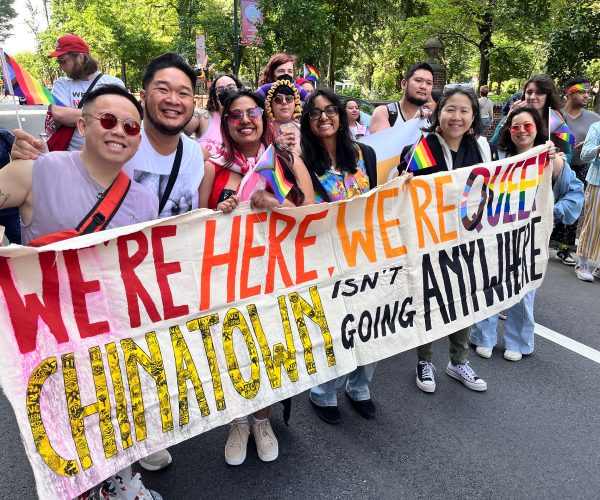
For many queer Asian American and Pacific Islander (AAPI) young people, identity doesn’t always come as a single, coherent thing. It comes as a set of tensions: between cultural heritage and sexual or gender identity, between family belonging and authentic self-expression, between communities that too often ask you to leave part of yourself at the door.
In emerging adulthood, a period defined by identity development, those tensions carry real weight. What does it mean to come into yourself when parts of who you are feel at odds? And what does it take to hold those identities together?
A new publication by Dr. Jennifer Tran of the Eidos LGBTQ+ Health Initiative at the University of Pennsylvania explores what that experience looks like.
The Problem: Identity Formation Gets Complicated
Identity formation, the process of understanding who we are and where we belong, is central to psychological wellbeing. For LGBTQ+ young people, that process is often harder. Stigmatizing cultural messages tell them their identities are wrong, impeding healthy development in ways that lead to higher rates of depression, anxiety, and suicidality, driven by rejection or lack of affirming community.
For queer AAPI youth, these challenges are more complex. Identity formation for queer AAPI youth can be understood through an intersectional lens. Intersectionality describes how different aspects of a person’s identity (e.g., race, sexuality, gender, class) don’t operate independently, but interact with one another within broader systems of power like racism, heterosexism, and colonialism. Queer AAPI youth therefore experience intersectional stress and stigma, a distinct form of pressure where systems of oppression meet and impact wellbeing.
Meet the Researcher: Dr. Jennifer Tran
Dr. Jennifer Tran, a researcher at the Eidos LGBTQ+ Health Initiative, identifies as a second-generation Queer Vietnamese American. Her new publication, “A Conscious Decision”: Intersectional Identity Formation and Understanding of Asian/Asian American Pacific Islander Sexual and Gender Diverse Youth,” draws from a larger study called SEEN (Sexual and Gender Minority Emerging Adults Eliciting Narratives). SEEN explored how personal storytelling can shape mental health outcomes for LGBTQ+ young people of color, offering participants space to narrate their own lives and generate knowledge from their own experiences. (For a fuller look at the SEEN study, see our earlier coverage.)

This new publication focuses specifically on 12 participants from that larger study — young people whose narratives offer a close-up portrait of what intersectional identity formation looks like for queer AAPI emerging adults right now.
What the Research Found
Feeling Like a Minority Within a Minority
Many queer AAPI youth described feeling like a “minority within a minority,” not belonging fully to either LGBTQ+ or cultural communities. In LGBTQ+ spaces, their racial identity could make them feel like outsiders. In AAPI spaces, their queerness was often invisible or treated as foreign. Queer AAPI youth described that these experiences made them feel “not enough.”
The Social Forces Shaping Identity
Identity doesn’t form in a vacuum. It’s shaped by the cultural, religious, and social environments we grow up in. Participants described several of these forces, and how each one complicated their relationship to their AAPI and LGBTQ+ identities.
Racism and colorism showed up in multiple directions. Participants who grew up in predominantly white neighborhoods described racial discrimination and feeling othered just for existing. There was even pressure within their own families to assimilate to American culture (i.e. only speaking English at home) which distanced them from their AAPI identities.
Many queer AAPI youth described that even within LGBTQ+ spaces, it was expected to experience racism. As one participant put it: “There’s still that thing of feeling kind of like an outsider in the sense of being a Person of Color within a queer space,” highlighting the complex intersectional experiences of exclusion and isolation from community.

"There's still that thing of feeling kind of like an outsider in the sense of being a Person of Color within a queer space."
-Study Participant
Religion compounded the difficulty for many. Participants who grew up in conservative religious households (e.g., Catholic Filipino communities and Korean evangelical churches) described how heterosexuality and cisgender identity were treated as moral givens and in many regards the only option.
Cultural erasure was described by many queer AAPI youth, where LGBTQ+ identity was simply not acknowledged within participants’ cultural communities. As one participant described: queerness was seen as “a Western or like American concept,” framed by some families as incompatible with their cultural identity.
Due to these tensions, many queer AAPI youth spoke about the complicated negotiations of coming out to family and cultural community members. One participant, wrestling with whether to come out as trans, voiced the fear that disclosure would change how people perceived them, that they’d be grouped and generalized in ways they couldn’t control. Fear of rejection by family, community, or broader society shaped these decisions.

Finding Integration
Not every participant experienced their identities as constantly in conflict. A few described understanding them as simply separate. One put it: “It’s more just like I happen to be queer, and I also happen to be Korean American.“
However, most queer AAPI youth spoke about what research calls Intersectional Identity Integration: the active, conscious choice to hold both identities at once and refuse to treat them as separate. “I am making the conscious decision,” one participant said, “to not feel like being proud of my queer identity has to take away from my Asian identity or vice versa.“
Building an integrated, affirming sense of self was described not as a destination but as an ongoing practice.
"I am making the conscious decision to not feel like being proud of my queer identity has to take away from my Asian identity or vice versa."
-Study Participant
What This Means for Mental Health Support
The findings point to a clear need for more nuanced mental health support. Approaches that treat LGBTQ+ identity acceptance as the only goal miss the larger picture for queer AAPI youth, whose psychological wellbeing is shaped by family, culture, and community alongside sexuality and gender.
Effective support means making space for intersectional identity integration, helping young people navigate the tensions between their cultural and LGBTQ+ identities. Research shows that a strong, coherent sense of racial and ethnic identity is itself a protective factor against psychological distress, which means affirming both identities together should be the goal of holistic support.
The diversity within AAPI communities also means that one-size-fits-all approaches will always fall short. Ethnic background, immigration status, generation, religious tradition, language, and geography all shape how experiences unfold. What queer AAPI youth need are spaces that are intersectionally-affirming, and that don’t ask them to leave any part of themselves behind.

Why Community Voices Belong in the Science
This study highlights the importance of research that centers lived experience. Qualitative research, which prioritizes participants’ own voices rather than reducing experiences to numerical scores, produces a different kind of knowledge than surveys alone. It captures texture, contradiction, and the specificity of people’s lives in ways no checkbox could contain.
For communities that have historically been overlooked, underrepresented, or studied only through lenses of deficit, this kind of approach matters. It captures complexity, acknowledges resilience, and ensures that people are understood on their own terms.
Honoring the Whole Self
AAPI Heritage Month is a moment to celebrate the richness and diversity of Asian American and Pacific Islander communities, and also to reckon honestly with what the community still needs. For queer AAPI young people, that means being seen wholly: not as AAPI and LGBTQ+ separately, but as complex and unique people whose identities are inseparable and intersectional.
Dr. Tran’s research is a reminder that honoring AAPI communities means honoring all of who they are, especially the queer youth.
The Eidos LGBTQ+ Health Initiative at Penn is committed to research, training, and community engagement that affirms the full lives of sexual and gender diverse people. To learn more about the SEEN study and other initiatives, visit penneidos.org.